Main caveat
It is powerful, but advanced apps can get complex to manage and the AI editing experience is still more partial than all-in prompt builders.
Selected profile
Non-coders who want real custom web-app logic and are willing to learn a visual programming model.
Visit official siteDirect answer
Non-coders who want real custom web-app logic and are willing to learn a visual programming model.
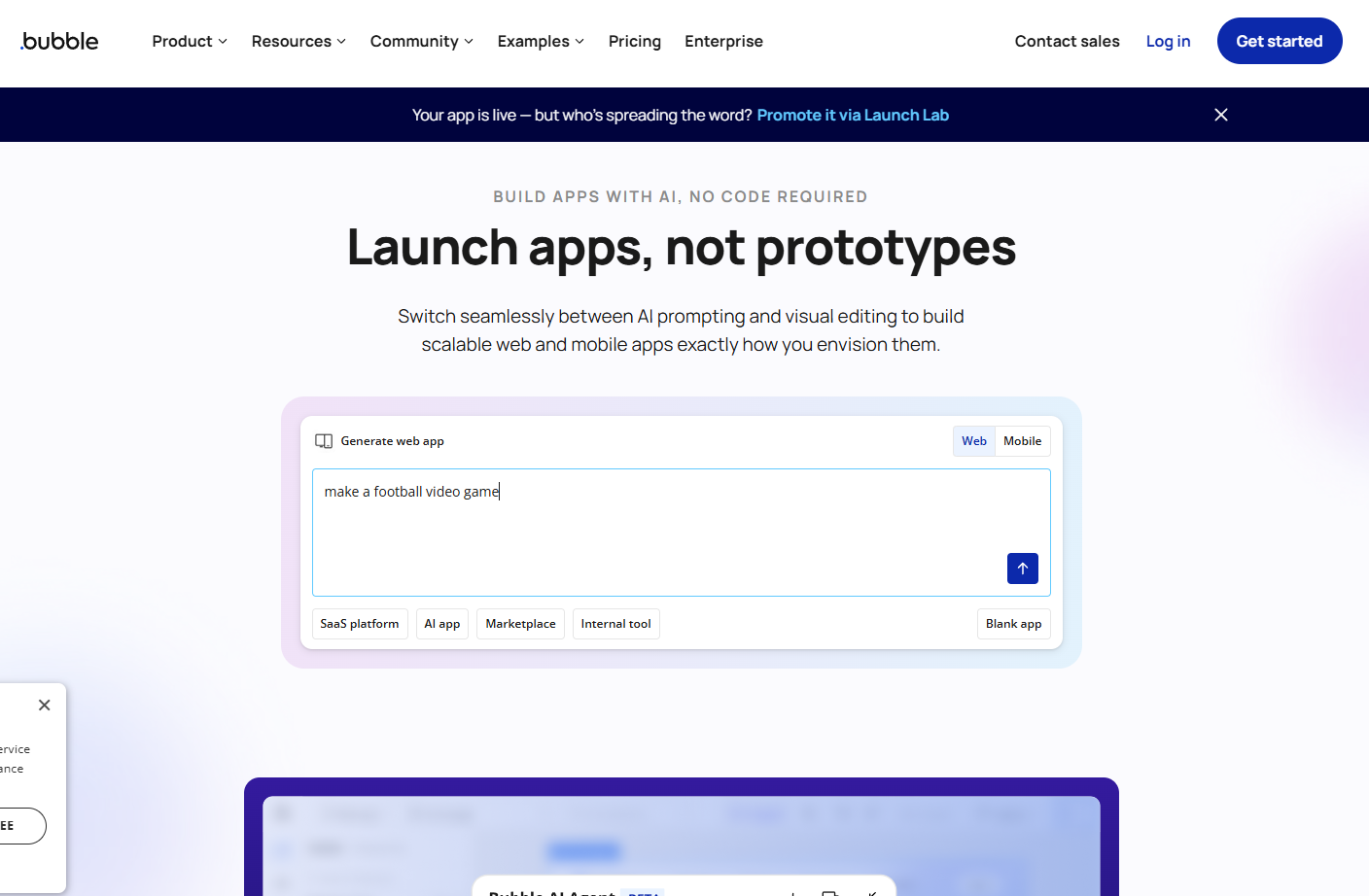
Non-coders who want real custom web-app logic and are willing to learn a visual programming model.
It is powerful, but advanced apps can get complex to manage and the AI editing experience is still more partial than all-in prompt builders.
bubble.io, manual.bubble.io
| Buying signal | Radar note |
|---|---|
| Technical comfort | No. Bubble is fundamentally no-code, though technical thinking still helps. |
| Data storage path | Native. Bubble includes its own database and privacy rules. |
| Experiment setup | No official native A/B testing feature found in the docs reviewed. |
| Payments or commerce | Usually third-party/plugin/custom workflow. Bubble can absolutely support stores or payments, but not through a single first-party ecommerce suite. |
| Ad monetization path | Third-party/plugin/manual. |
| Search visibility | Native. Bubble has documented SEO controls and settings. |
| Traffic and product measurement | Usually third-party/plugin for product or marketing analytics. Bubble has logs and platform metrics, but not a standout native website analytics suite. |
| Natural-language creation | Yes. Bubble AI can generate app structures and UI from prompts. |
| Natural-language iteration | Partial. Bubble AI Agent can create or modify some elements, but the visual editor is still a major part of editing. |
| Public launch without domain purchase | No. Bubble-hosted URLs exist first; custom domains are optional. |
| Release workflow | Develop in a Bubble app, then deploy to live and optionally attach a custom domain. |
| Interactive or game-style builds | Limited. Simple browser games are possible, but Bubble is not ideal for game-heavy apps. |
| Stored form submissions | Yes. Forms and workflows can store submissions natively. |
| Multiple-user experiences | Yes. User accounts, privacy rules, and workflows support multi-user apps. |
| Sharing handoff | Easy to share live apps; collaboration is also well supported. |
No. Bubble is fundamentally no-code, though technical thinking still helps.
Native. Bubble includes its own database and privacy rules.
No official native A/B testing feature found in the docs reviewed.
Usually third-party/plugin/custom workflow. Bubble can absolutely support stores or payments, but not through a single first-party ecommerce suite.
Third-party/plugin/manual.
Native. Bubble has documented SEO controls and settings.
Usually third-party/plugin for product or marketing analytics. Bubble has logs and platform metrics, but not a standout native website analytics suite.
Yes. Bubble AI can generate app structures and UI from prompts.
Partial. Bubble AI Agent can create or modify some elements, but the visual editor is still a major part of editing.
No. Bubble-hosted URLs exist first; custom domains are optional.
Develop in a Bubble app, then deploy to live and optionally attach a custom domain.
Limited. Simple browser games are possible, but Bubble is not ideal for game-heavy apps.
Yes. Forms and workflows can store submissions natively.
Yes. User accounts, privacy rules, and workflows support multi-user apps.
Easy to share live apps; collaboration is also well supported.
Compare it against tools in the same buyer path, especially the feature chart and all-reviews index.