Main caveat
It is not as all-in-one as Lovable or Bubble unless your app needs are relatively simple.
Selected profile
Teams that care about custom front ends and are willing to connect a real backend such as Supabase, Xano, or custom APIs.
Visit official siteDirect answer
Teams that care about custom front ends and are willing to connect a real backend such as Supabase, Xano, or custom APIs.
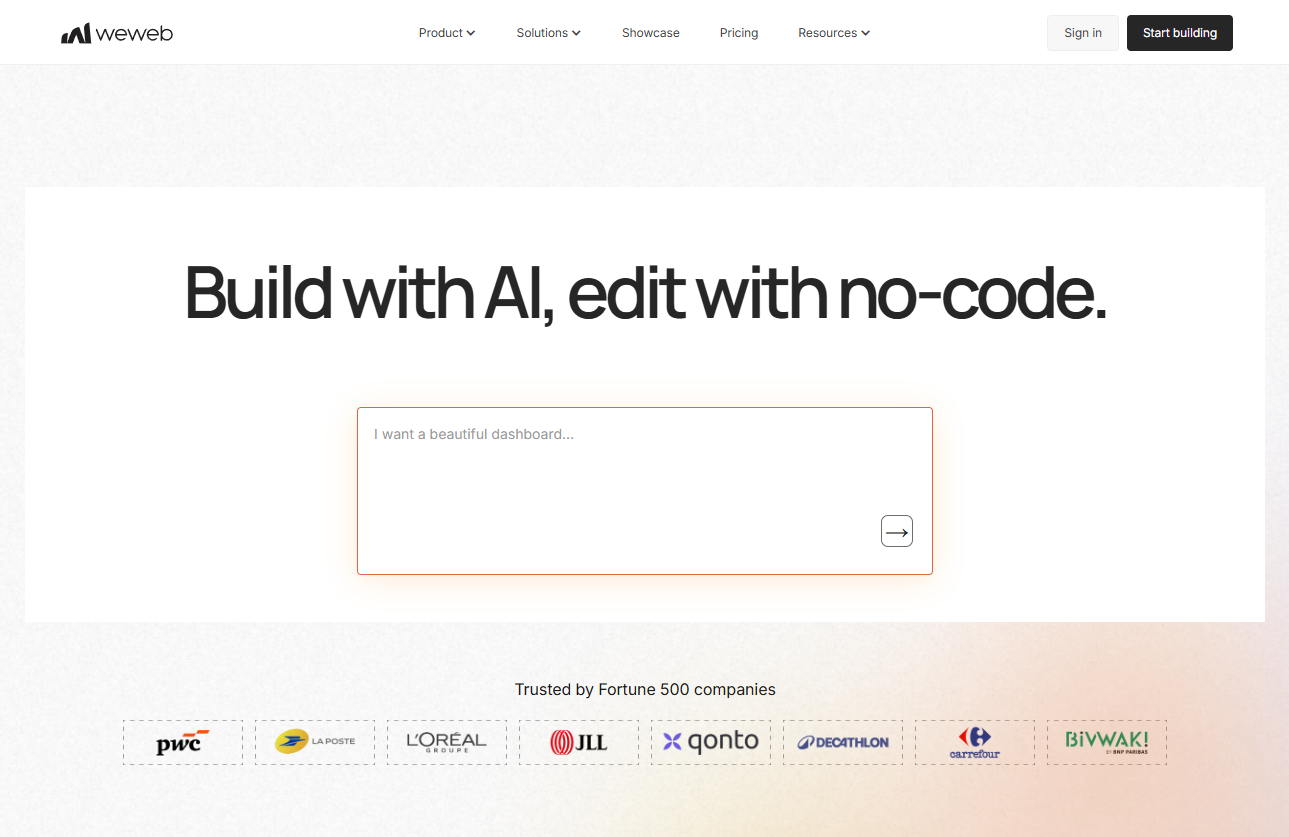
Teams that care about custom front ends and are willing to connect a real backend such as Supabase, Xano, or custom APIs.
It is not as all-in-one as Lovable or Bubble unless your app needs are relatively simple.
weweb.io, docs.weweb.io
| Buying signal | Radar note |
|---|---|
| Technical comfort | No for basics; helpful for advanced cases and custom components. |
| Data storage path | Usually third-party for core app data. WeWeb is front-end-first, though WeWeb Auth reduces the need for a separate auth layer. |
| Experiment setup | No official native A/B testing feature found in the docs reviewed. |
| Payments or commerce | Third-party/manual. |
| Ad monetization path | Third-party/manual. |
| Search visibility | Native. WeWeb documents page SEO features and static content options. |
| Traffic and product measurement | Official integrations rather than native analytics. Segment and GTM-style integrations are common. |
| Natural-language creation | Yes. |
| Natural-language iteration | Yes. |
| Public launch without domain purchase | No. WeWeb provides preview/hosted URLs first; custom domains come with hosting plans or self-hosting workflows. |
| Release workflow | Publish on WeWeb hosting or export/self-host, then connect a custom domain if needed. |
| Interactive or game-style builds | Limited. Simple browser experiences are possible, but games are not its main focus. |
| Stored form submissions | Yes, if connected to a backend or form-handling setup. |
| Multiple-user experiences | Yes. User auth, roles, and connected backends make multi-user apps viable. |
| Sharing handoff | Easy. |
No for basics; helpful for advanced cases and custom components.
Usually third-party for core app data. WeWeb is front-end-first, though WeWeb Auth reduces the need for a separate auth layer.
No official native A/B testing feature found in the docs reviewed.
Third-party/manual.
Third-party/manual.
Native. WeWeb documents page SEO features and static content options.
Official integrations rather than native analytics. Segment and GTM-style integrations are common.
Yes.
Yes.
No. WeWeb provides preview/hosted URLs first; custom domains come with hosting plans or self-hosting workflows.
Publish on WeWeb hosting or export/self-host, then connect a custom domain if needed.
Limited. Simple browser experiences are possible, but games are not its main focus.
Yes, if connected to a backend or form-handling setup.
Yes. User auth, roles, and connected backends make multi-user apps viable.
Easy.
Compare it against tools in the same buyer path, especially the feature chart and all-reviews index.